
Exhibitions
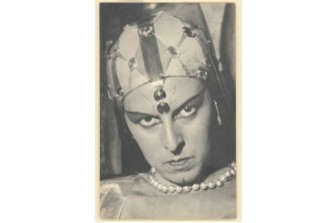
This Sex Which is Not One*
Group Exhibition
The trans-feminist movement addresses feminist issues from a transgender perspective. Similarly to other third-generation feminist movements, trans-feminism often examines the effect of body image and the oppressive and destructive power of the binary gender conception.
Saturday, 01.08.20
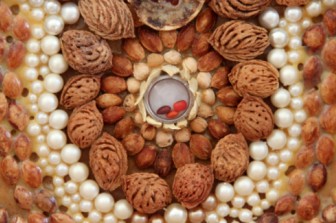
The Mother Goddess
Group Exhibition
In this exhibition, a common thread connects between miniscule, prehistoric clay figurines dating from 8,000 years ago, found at the Sha'ar HaGolan archeological site; medieval images of women inspired by Tarot cards; and the works of four contemporary Israeli women artists.
Saturday, 01.08.20
Curator: Michal Shachnai Yakobi
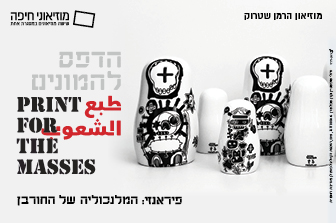
"Print for the Masses" and "Piranesi: The Melancholy of Destruction"
Today print has become a diverse medium that combines traditional printmaking with new materials and production methods. Digital technologies, for example, have been swiftly integrated into the printmaking process, while traditional techniques have come to rely on photocopiers, fax machines, and inkjet printers. These new technologies have not made other methods obsolete, but rather have expanded the range of options and possibilities in the print medium.
Monday, 19.10.20
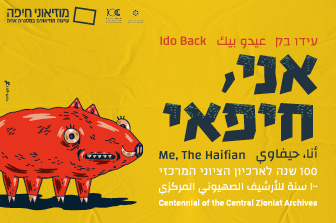
"Me, the Haifian"
In honor of the CZA's centennial, a number of exhibitions in museums throughout Israel will present materials kept in the archives. The Haifa City Museum has chosen to focus on the collection of Haifa posters and broadsides preserved in the archives. The collection affords an opportunity to learn about daily life in Haifa, about the different ideologies that characterized different periods in the life of the city, and about local graphic designers and printing houses.
Saturday, 19.06.21
A Different Perspective on the Collection
Registrar’s Choice
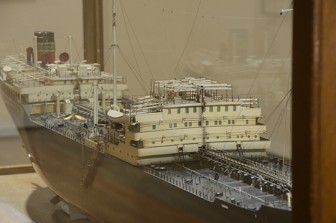
The National Maritime Museum’s collection began nearly 70 years ago. Over the course of this time thousands of items have been collected, and it is always interesting to learn about a particular work’s history, such as how it came to be in the collection.
Saturday, 07.05.22
"Black Milk"
Belu-Simion Fainaru
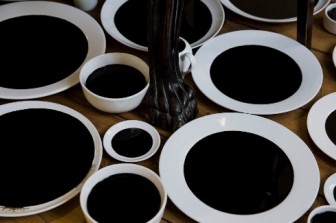
In his work Black Milk, Belu-Simion Fainaru invites the viewer to contemplate a work that is densely detailed yet whose characteristics are minimal, emphasizing a universal dimension. The black, toxic machine oil, threatening and repelling, is held in white, delicate porcelain utensils with understated decorations. The table and chairs belong to the past, to the artist's parents' living room. This is a forgotten world – one in which we do not await a ghost meal, a meal that will never take place. The sense of absence and nothingness is a continuation of the installation Belongs Nowhere and to Another Time, exhibited at the 2019 Venice Biennale, where Fainaru was chosen to represent Romania.
Monday, 17.05.21
"No Windows"
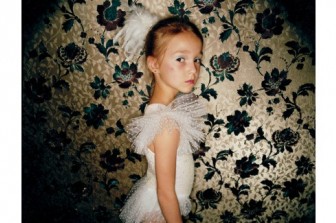
The present period, when many of us are alone and confined to one room, is perhaps a time to contemplate depictions of "horror rooms" familiar from art history. Throughout this history we encounter images of empty, cold rooms conveying a sense of loneliness, insecurity, and fear. A special historical place is reserved for depictions of sealed rooms, lacking windows or doors, such as prison cells, graves, churches, theaters, reading rooms, or collection chambers. These spaces do not allow the occupant to gaze outside, illuminating only that which lies within.
Monday, 17.05.21

"Endless?"
During the months of coronavirus lockdown, we were inundated with a stream of jokes, videos, and memes. WhatsApp, Facebook, and Instagram were filled with jokes hoping to put a smile on people's faces and dispel, if even for a short time, the depression and sense of crisis caused by the pandemic, with its accompanying social isolation and economic hardships. Many WhatsApp and Facebook groups were created by professionals from the health and care professions who sought to lighten their difficult routine and offer participants moments of laughter and solidarity.
Monday, 17.05.21
Spaces in Turmoil
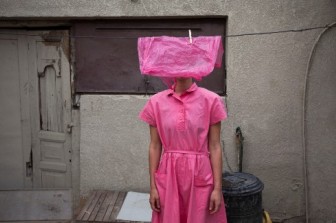
The coronavirus crisis and its widespread effects have revealed the fragility of our existence in our most private spaces, as well as in the general social order. This is a period of fear and insecurity, yet also one of potential insight. It allows us to see through the cracks in the foundations of our existence and reexamine them, though the encounter may be distressful and shocking.
Monday, 17.05.21
"Lines of Light Ranged in the Nonspace of the Mind*"
It is surprising to find that virtual space is in fact based on ancient cultural principles. A strange space, with no taste or smell, wind or sun – a binary space made up mostly of combinations of the numbers 1 and 0, that we experience through a bright screen, as if peering through a "window". Still, this "environment" is based on the same mathematical principles that underlie our perception of space and the science of perspective as they were developed in the fourteenth and fifteenth centuries. The illusion of a familiar space that functions according to familiar laws conceals the reality of a virtual environment, in which our body has no existence, and neither do our physical experiences or specific viewpoint.
Monday, 17.05.21
Please contact us and we will contact you as soon as possible